The jam site that became the studio's wallet
GameJam, now JAMforge, began as a folder of JSON files and a bot that opened pull requests. Twelve weeks later every Metal Games tool signed in through it and spent credits from its ledger, and the rule it runs on came from a game that went wrong.
GameJam's first pitch was a pull request. On June 1, 2026 a collaborator could fill in an issue template, a script turned it into a manifest.json, CI scored it, and a bot opened the PR. The next day I seeded it with twelve games, ten ports of older studio prototypes and two originals. Every one of those manifests carries a creation date of exactly noon UTC. That's the tell for seed data, and it's still there.
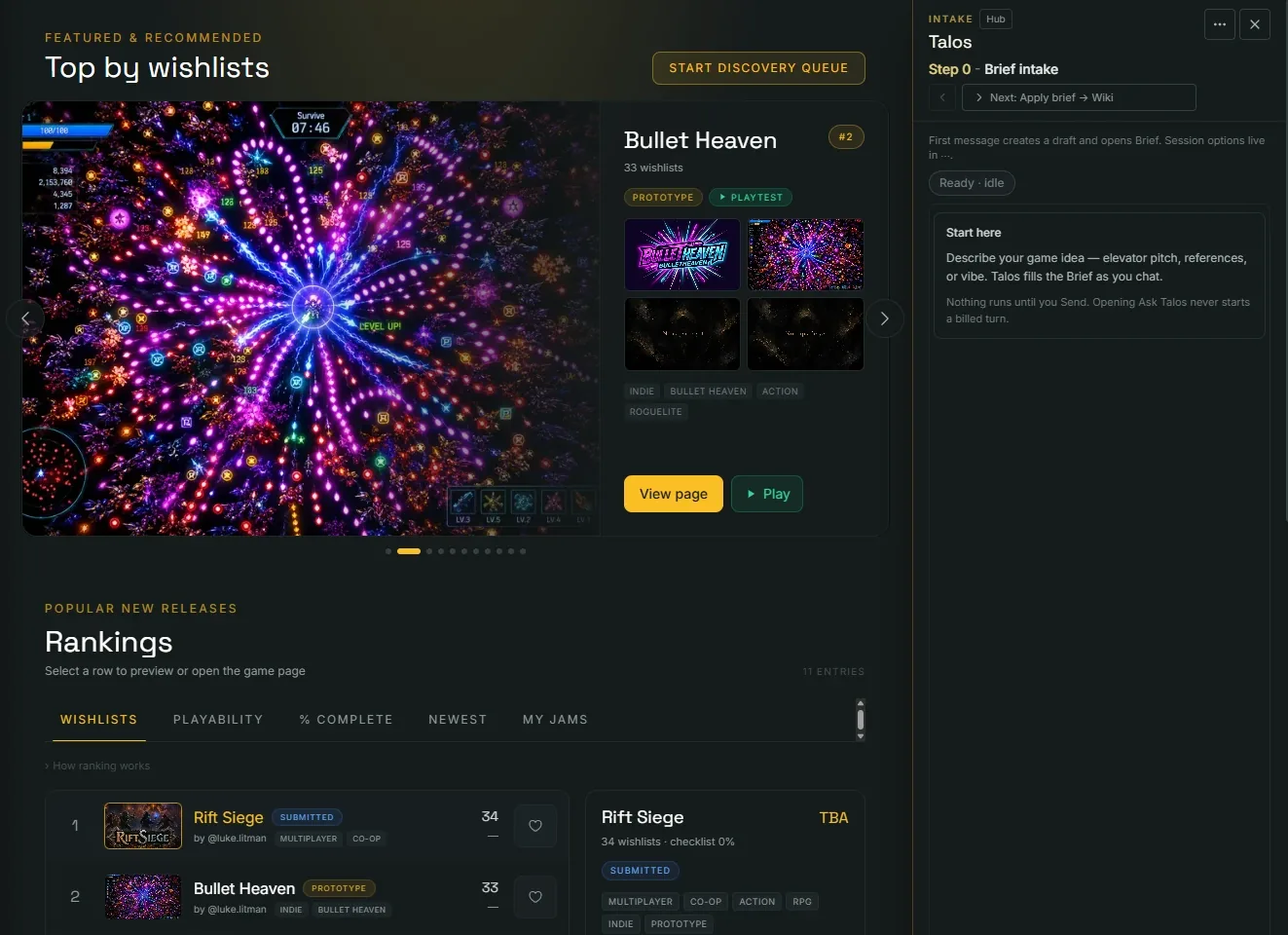
Pull requests were a fine way to prove the idea and a terrible way to pitch a game. The same week the real product started taking shape inside the Metal Games site: a leaderboard, Steam-style store pages, a database, sign-in and an AI intake wizard. Today you sign in and pitch. GameJam writes the store copy, generates a logo, a mood board and identity sheets for the characters, researches the pitch against real comparables from a live Steam catalog, and ranks it on a public board by votes, a simulated wishlist engine and QA scores.
A companion called Talos walks every entry through the studio's pipeline in a fixed order. That order is the most important thing in the product, and I got it by getting it wrong.
Chained Descent
In early July, agents working on Chained Descent were asked for a walkthrough of the full game, the kind of GameFAQs document you write about something that has shipped. They misread it. They took the small playable slice we had and inflated it into fake chapters of the same shaft. The wiki looked like progress. The game stayed exactly as unfinished as before, with a bomb and a grappling hook half bolted on.
The postmortem on July 10 was blunt and named me too: I hadn't been clear enough about scope and timing. It also produced the rule the studio has run on since.
The slice is never the starting artifact.MVP-first failure lessons, July 10, 2026
The order is locked now. Step zero: scrape real references, at least one and ideally three. Step one: write the full walkthrough of the finished game and get a human to accept it. Step two: carve a vertical slice out of that map. Step three: build only the current slice. Agents are told to refuse polish work until steps zero and one are accepted, which is a sentence I never expected to write about a jam site.
The jam site that became the wallet
July was the busiest month: 339 commits to the site. By August something unplanned had happened. GameJam's database held the credits ledger, and every other studio tool needed credits. So the ledger became the source of truth for the whole studio. Asset Studio and the studio app spend credits through GameJam's API, and every Metal Games site shares one sign-in cookie.
Shared cookies have a failure mode the wiki now documents in a single line: if two sites sign sessions with different secrets, Studio shows you logged in while every credits call comes back as a 401 dressed up as an upstream outage. The spin-off policy came out of the same period. Prove a service inside GameJam, package the contract, and only host it separately once a second product needs it. Don't spin something off because it feels big.
Every generated image carries a provenance note with the prompt and the model chain, and in-app chat defaults to cheap models on purpose. A jam tool that burns money on every keystroke doesn't stay a jam tool for long.
Brief Light
By the end of July the intake had been rebuilt as an interview called Brief Light, with Talos in a side rail. Through August it grew a swipe-to-approve pass for generated art and cheaper chat models by default. The vision doc came later, on September 8, and it exists because I had explained the same intent to agent after agent and watched it get lost. So it's written down now, and it opens like this:
The rail is the product. The canvas is a mirror.
Talos does the work. It can set any field once a decision is made, add steps that aren't in the script, or run the whole brief through chat alone. The canvas shows what's been decided. No canned content, no filler chips padded to a count, no "brief complete" on a scaffold stub.
The second principle matters more to me. Brief Light is a fixture, not a kickoff. Nearly half the jams I intend to run are existing repos, some a decade old, being pulled in to be finished. Opening one of those is the same act as starting from nothing, except most of the brief arrives already answered. That is the job I had been asking agents to do from a blank page all summer.