A brand studio whose busiest client is itself
IronReach is the name over every other name I ship under. Its site is one HTML file, it sat untouched for four months, and its best tool refuses to pretend a launch can be automated.
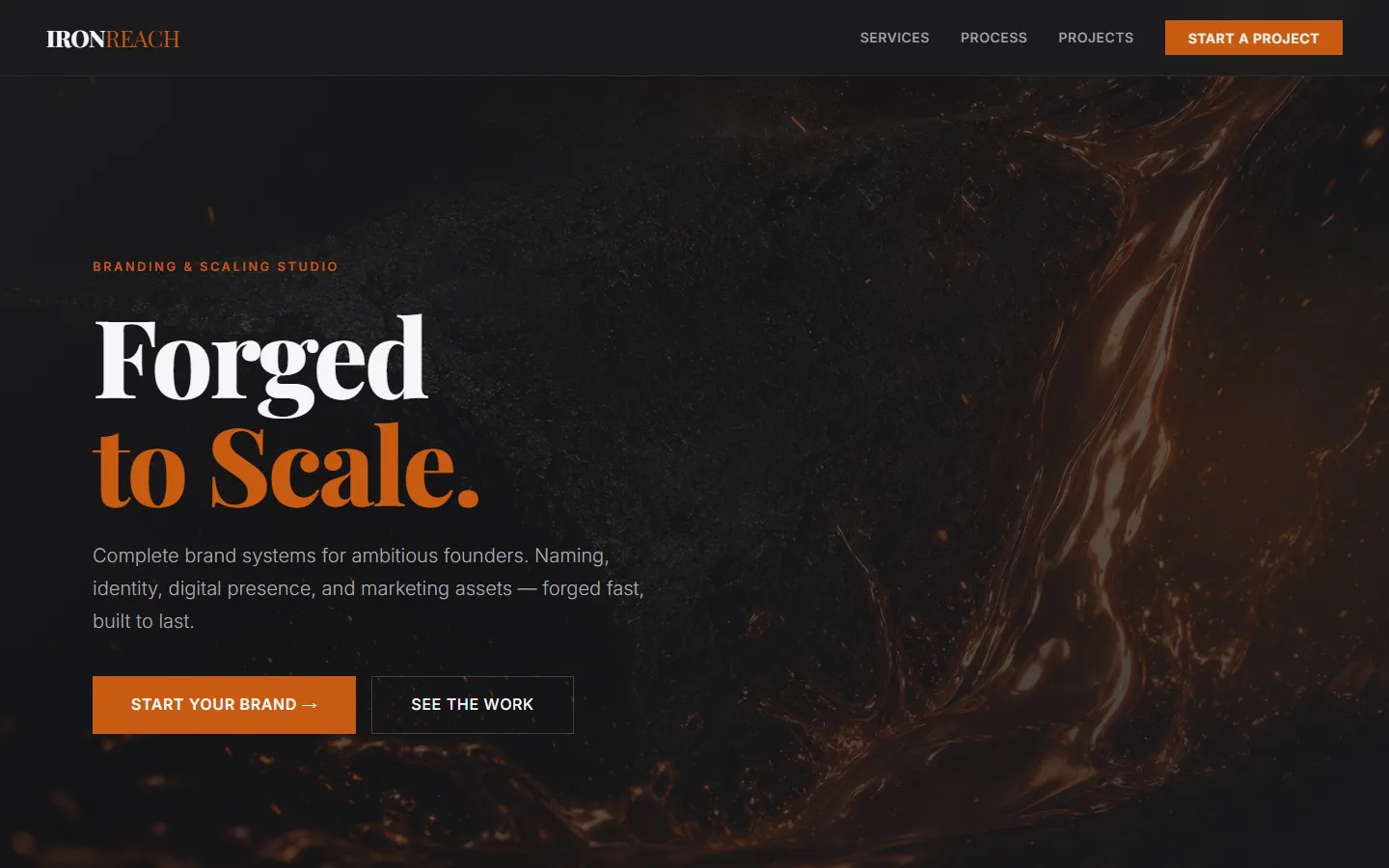
Every project on this site has a name, a wordmark and a domain. Most of them are mine. IronReach is the name over all of them: the branding and scaling studio I run contract work through, formerly Slook Design, forged in Austin, Texas. If you're reading this on portfolio.ironreach.xyz, you're standing inside it.
That makes it an odd kind of studio. Its case studies are Metal Games (the flagship), MetaSin Games and Cursebound, Deep Forest Labs, GameJam (now JAMforge), HEPHforge, and Empelt, a single-harvest olive oil from Tarragona and the one client with nothing to do with games. For most of those brands I also build the product. A brand studio whose first and busiest client is itself finds out quickly which of its own rules it actually follows.
One file
The site went up on May 18, 2026 as a single hand-written HTML file, 703 lines, plus a hero image. No framework, no build step. Forge Black, Molten Copper, "Forged to Scale." Six services, a seven-phase process, a contact button. Three days later it got an easter egg: click the forge mark in the footer and it calls this portfolio's achievement API and unlocks Iron Reacher here. The achievement system itself had shipped the same day. Two sites, one trophy.
Then nothing was committed for almost four months.
Naming the tools
The gap wasn't idle. The most useful thing IronReach did in that stretch was for Metal Games: a dozen internal tools had grown organically (a deploy gate, an asset pipeline, data packs, a skill library, a builder) and none of them read as one product. HEPHforge is the naming system that fixed that. A studio layer, a product-suite umbrella, a creator persona held in reserve, and a consistent -forge pattern across every tool, each with its own persona, accent color and voice. GATE. ANVIL. NODE. THE HALL.
The part of that work I'm proudest of is the kill list: a written record of naming dead-ends (Lanyard, Multipass, Warden, invented metrics) so nobody re-proposes them when the next tool ships. And one governance rule that case studies rarely bother to show: HEPHforge is the name people see, and HALLforge stays an internal slug. Naming discipline is mostly the discipline of writing down what you rejected.
A launch tool that stayed a checklist
In late May I also built ironreach-ops, a command-line tool for launching a brand across ten platforms: X, Instagram, Facebook, LinkedIn, YouTube, TikTok, Bluesky, Reddit, Discord and Threads. It validates a project profile, plans the rollout and drafts the tasks into Linear. Dry-run is the default. Going live takes two separate flags.
Every step is typed as one of three things: something an API can do, something a browser can assist with, or something a person has to do. Run it on the sample profile and you get 30 steps and 450 estimated minutes, and only the last step for each platform, scheduling the launch-day post, is an API call. Claiming the account and applying the brand are a human's job. I set out to automate a launch. What I built was a tool that tells the truth about how little of a launch is automatable, which turned out to be the more useful thing. The sample profile still describes IronReach as a game, "strategic survival in a fractured frontier," and nobody has corrected it.
The quiet failure
The four-month gap ended on September 13 with the thing I'd been putting off. The contact button was a mailto: link. It works for anyone with a desktop mail client and does nothing at all for everyone else. Nobody sees an error and nobody complains, because from their side nothing happened. They leave.
On a studio site, a mailto link is a bug.
It became a real form backed by a small serverless function that sends the message over SMTP, with a hidden honeypot field for spam and a fallback address if anything fails. The first deploy didn't pick up the new environment variables, so the commit history has an empty commit whose only job was to force a redeploy. The same day, the work section became case studies generated from one data file, so adding a client is an entry, not a page. Skyburn is in there too, labeled for what it is: my earlier work at INK Games, not an IronReach client. A portfolio that blurs that line is easy to write and hard to defend.
Nine days later this portfolio got the same fix. The studio's first client is still the studio, and it still files the bugs.