My AI gateway lost to OpenRouter sixty times, on purpose
GATEforge is one key in front of every AI account you already hold. It was built by a loop that measured it against OpenRouter after every piece. Then it got a name, a face, a color, and eleven siblings.
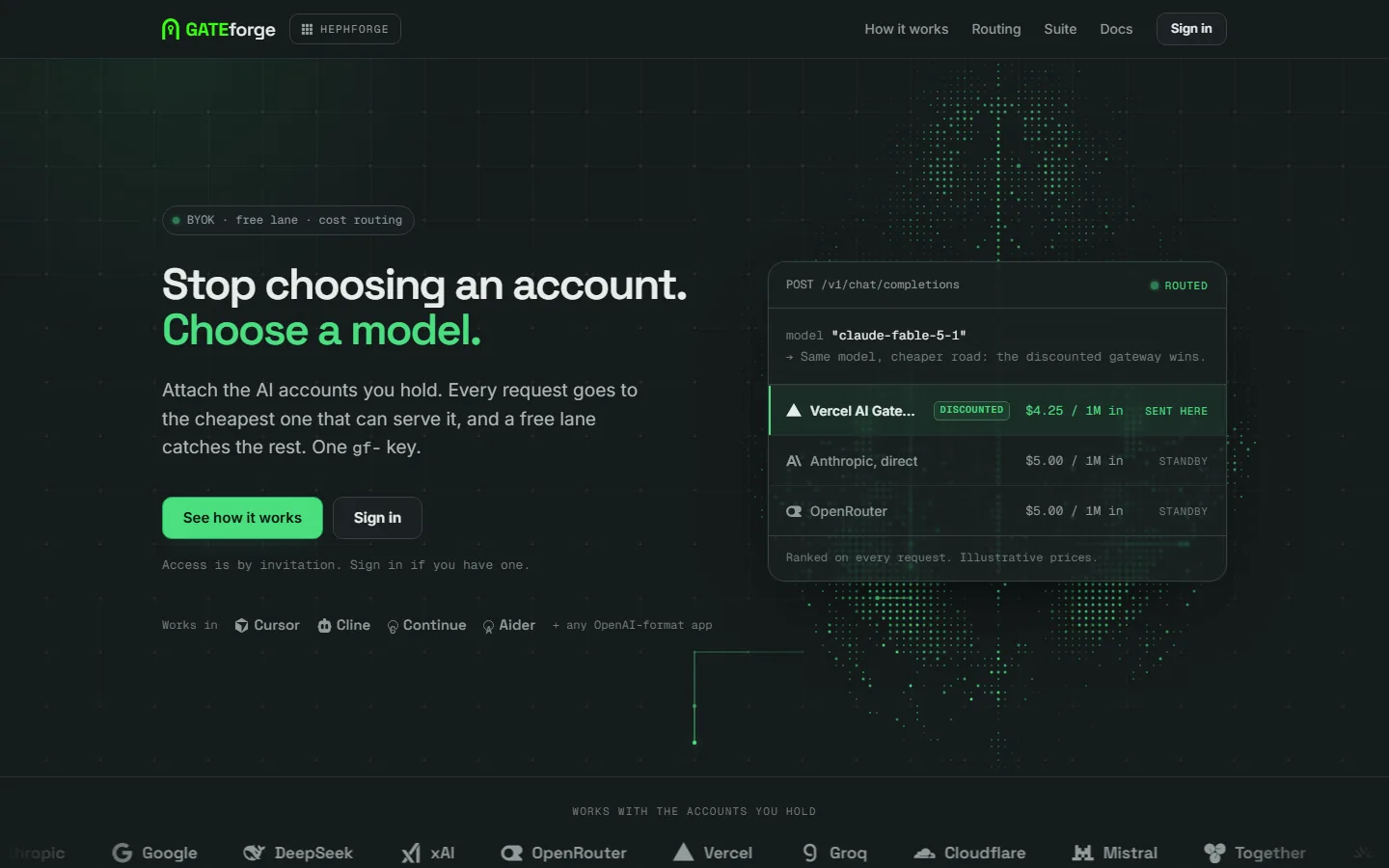
GATEforge is the piece everything else in the studio leans on. One key, beginning gf-, in front of every AI account you already hold. Paste it into Cursor and the models on those accounts answer from there, at the prices you already pay. Attach two accounts and each request goes to whichever one is cheaper for that model right now. A free lane answers the things you have no account for. Every other tool in the suite signs in through it and draws its models through it. A tool that tried to run its own vendor key would go cold.
It was born on August 23, 2026, the same day as the rest of the fleet, with 182 commits before midnight. Then it lost to OpenRouter sixty times in a row.
Sixty losses
The loop was the one from the HEPHbuild entry: cut the work into numbered pieces, build one, have a critic compare it against a bar. For GATE the bar was OpenRouter, captured as frozen snapshots of its keys page, its activity charts and its sign-in. The critic picked the bar for piece 1, API keys. It picked the bar for piece 2, spend caps. Of the first 61 verdicts GATE won exactly one, piece 25, a toolbar polish. In the commit log "critic pick bar" appears 60 times and "critic pick ours" once.
That was the point. Each loss came with a sentence naming the gap, and the sentence became the next piece. Piece 26: no self-service registration. Piece 27: no GitHub or Google sign-in. Piece 29: no passkeys. Piece 40: the sign-in card sits inline on the page while OpenRouter's is a centered dialog over a dimmed backdrop. Piece 48: the mobile nav had been amputated. Thirty-three pieces went into the sign-in card alone, until piece 59 said the only gap left was OpenRouter's Clerk runtime itself, and that was out of scope. A critic that never says you've won is only useful if every loss tells you what to build next. This one did.
The retrospective for the two days after was less flattering. Production went live at gate-forge.metalgames.xyz by August 25, with OAuth, a custom domain and a settings page, and not one of those pieces went through a critic. The report's verdict line reads "zero blind wins this session." It also caught a real bug: my shared development database already had an accounts table from another project, and GATE's migrations had been quietly failing against it. The server now refuses to start if it finds the wrong table.
Choose a model
The feature that made GATE worth a landing page came a week later. I wrote the cost-optimized routing spec on August 31. It shipped on September 6, and the spec had to be edited to stop saying nothing here is built yet. Three rules. The cheapest route that can actually serve the model wins, and a provider whose catalog lacks the model is skipped rather than tried. Price beats the manual order you set six weeks ago. It's a per-account switch, off by default. It never swaps the model you asked for, only the road to it, which is what separates it from the auto-routers that pick a different model on your behalf. OpenRouter announced one of those the same day I wrote the spec.
A name, a face, a color
Until September the suite had no name, and the tools had been named the way tools get named at two in the morning. The sign-in page said Metal Games. The landing was written for a working name, Lanyard, and its persona was called Warden. On September 7 that got locked: Metal Games is the studio, FORGE is the suite, Haephestus is the maker and stays in the back room until he's minted, and every tool keeps its host and repo name whatever its wordmark says. A second doc the same day corrected the roster. The personas had drifted into Cyclopes, Dactyls and Charon, real figures from Hephaestus's circle but not what I'd asked for. In the Iliad the smith's helpers are golden maidens with mind, voice and the knowledge of the craft, and Homer gives the class and not one name. So every bot became a maiden, and each took a two-syllable working name: Janus at the gate, Hali on the wall, Cora on the rail, Ember at the anvil, and so on to twelve.
The messaging pass went to a writing agent called Fable, from a sealed handoff by a messaging agent called Quill, with visuals from Brush and fleet operations from Cap. Fable produced a brand core, a back story, a suite circuit, a visual system, twelve maiden dossiers and a decision log. I answered the log at 11:53 that morning. The rail product was renamed from MAIDEN to RAIL, because you can't name one of twelve maidens Maiden. The progress stages became Ore, Heat, Strike, Quench and Temper. And every tagline candidate was rejected for putting the suite in a game box. Unreal doesn't say game engine in its tagline. Neither do we.
The day that got reverted
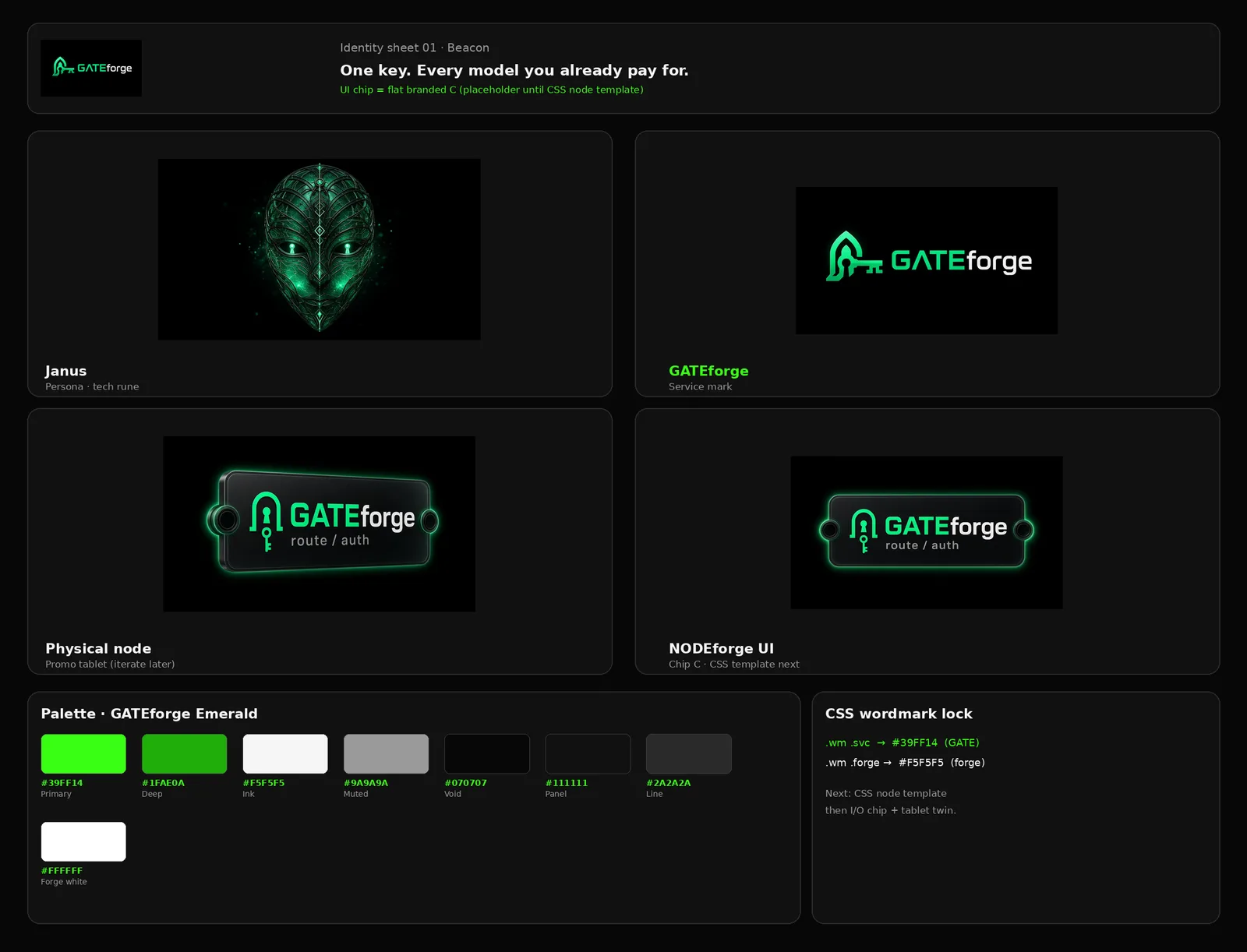
September 8 was 61 commits and sixteen pull requests on the gate alone. Brush delivered an emerald identity pack: a wordmark with a key for a mark, a Janus portrait as a tech rune, a palette led by a green that reads from across a room. The dashboard lost its orange. The landing got a new H1, then another, then a route diagram with a power-inlet motif, then the same diagram with the inlet killed, then a Meet Janus card, then the card removed, then the card's dead CSS scrubbed. The last pull request of the day put the landing back to where it had been that morning and kept the identity pack. The Hub had the same day in miniature: one pull request that invented things it had no evidence for, rolled back to the version before it, with "no invent" in the commit message.
The identity pack survived because it was one decision. The landing didn't because it was sixteen decisions made by a room full of agents in one afternoon. Five days later the twelve service landings were generated from the bible instead of written one at a time, each with its own accent color pulled from one JSON file.
The beacon pass
The pass that stuck ran on September 25 and started with a peer scan of twelve landing pages: OpenRouter, Vercel AI Gateway, Portkey, LiteLLM, Helicone, Cloudflare and six more. The category headline is a template now, "The AI Gateway for" somebody, followed by hundreds of models, one key, no markup. Everyone counts something: models, providers, developers, tokens. Nobody leads with the accounts the reader already holds. So GATE does. The H1 I picked was the seventh of the candidates: "Stop choosing an account. Choose a model."
The rest of the pass was rules, and they went into the bible as rules. Dark only, and no pure black: a neutral scale called forge slate. Two accents per tool, a brand color for the mark and a calmer one for buttons, because the emerald that reads on a wordmark burns on a form field. The hero is always two lines on desktop, sized from its column. Janus is no longer a picture; she's drawn as dots on the page's node grid, lit where the pulses pass, and no image pixels reach the page. And the honesty stamps came off. Since September 7 every feature had carried "live today" or "in the shop" or "parked." Now the page sells only what works, stated flat, and everything else lives under one heading called Roadmap. The honesty moved from the labels into the structure.
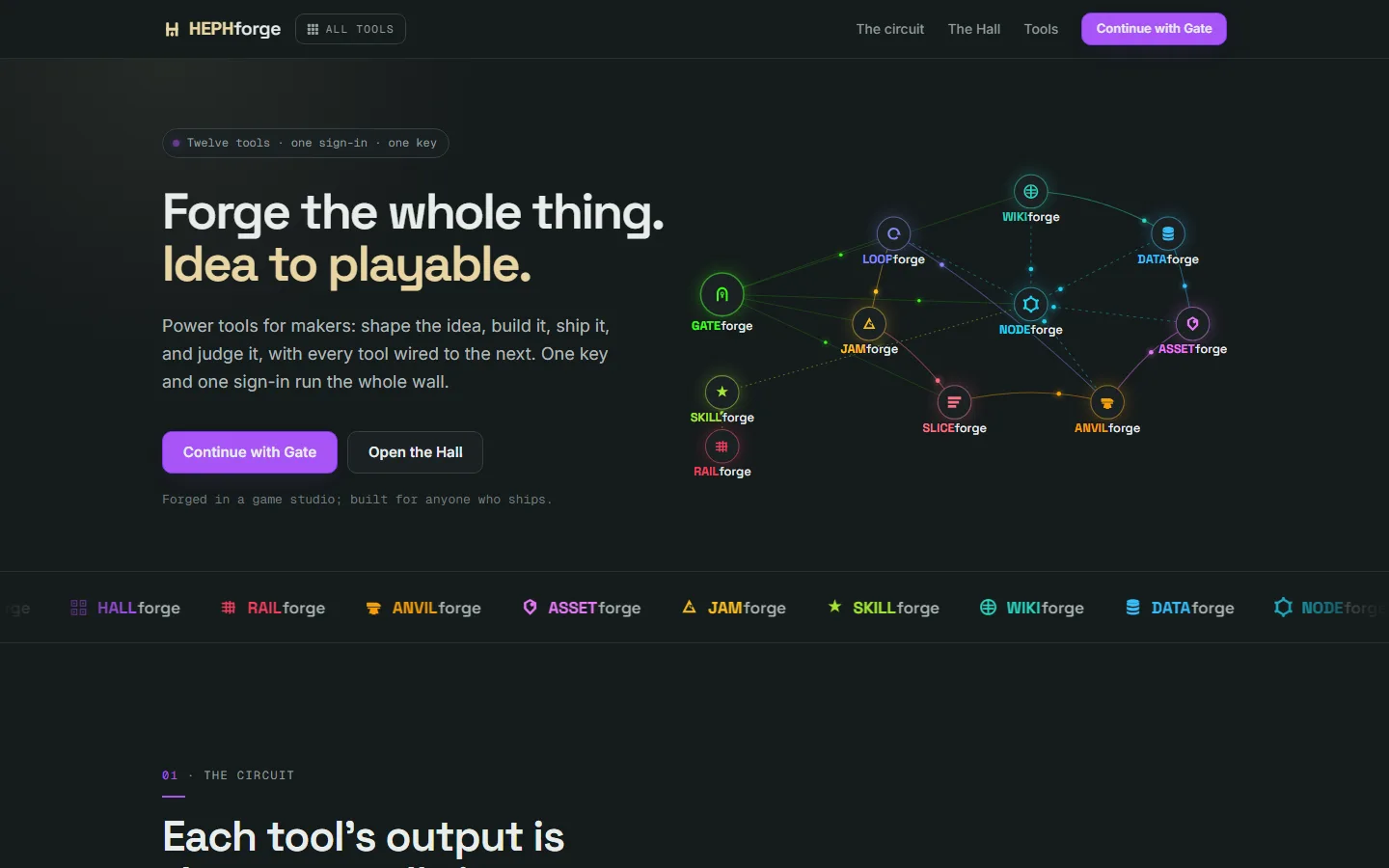
That night the same tokens, the same kit and the same rules were ported into the Hub. Its front door became "Forge the whole thing. Idea to playable." with the suite drawn as a live graph, GATE as the spine feeding every node. The Hall was rebuilt on the same graph. All twelve forge landings were regenerated at parity with GATE's, each wearing its own color, each hero showing the tool as a node with its hand-offs. The public name of the suite changed one last time, from FORGE to HEPHforge, and "Metal Games services" joined the kill list. Metal Games is the studio credit in the footer now, and nothing else.
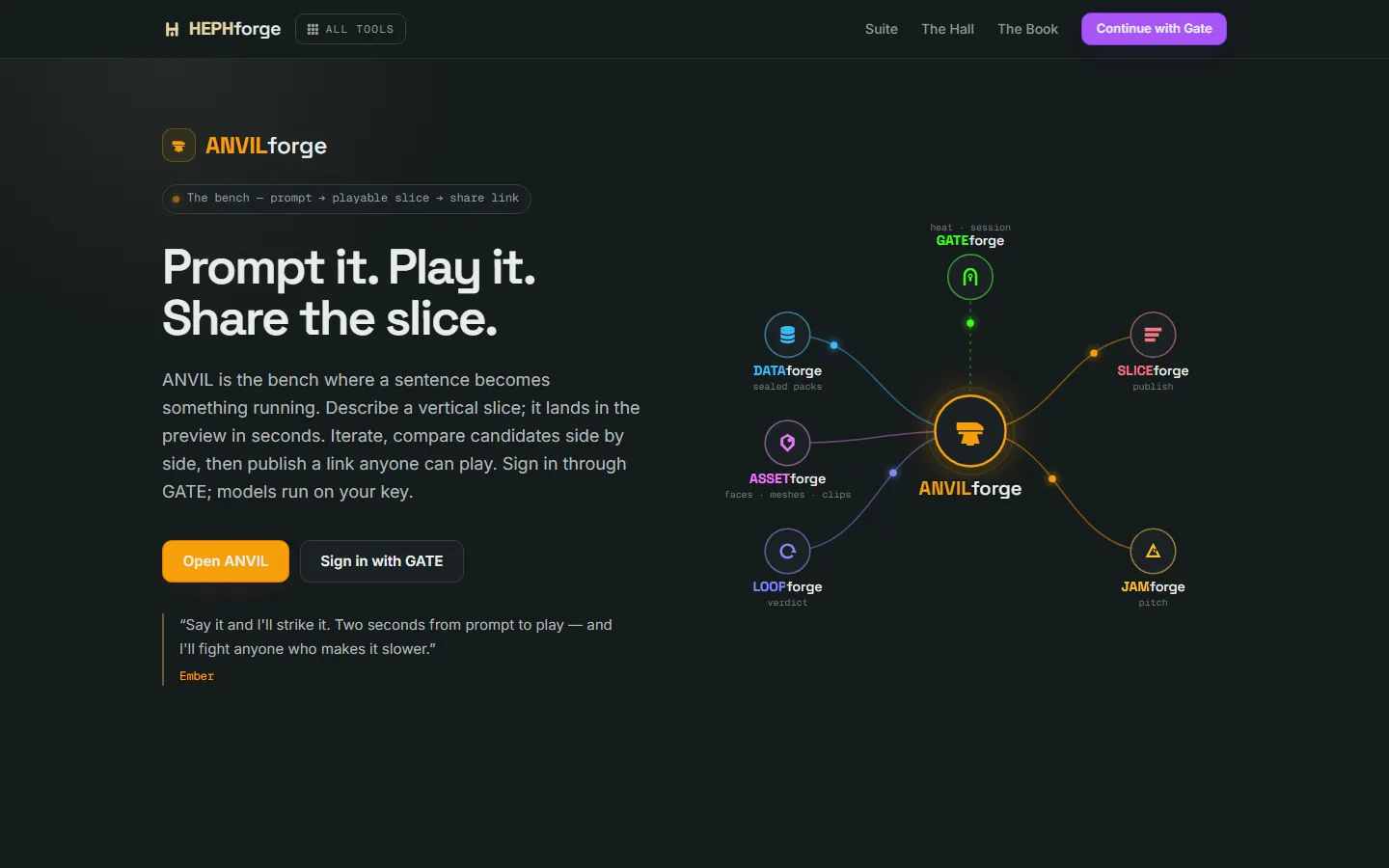
The merge landed on September 26. The first fix after it was that signed-out visitors saw the styles collapse, because the sign-in gate that bounces every operator page to GATE had been bouncing the token stylesheet too. One key really does open the whole wall. It had also been locking the paint.